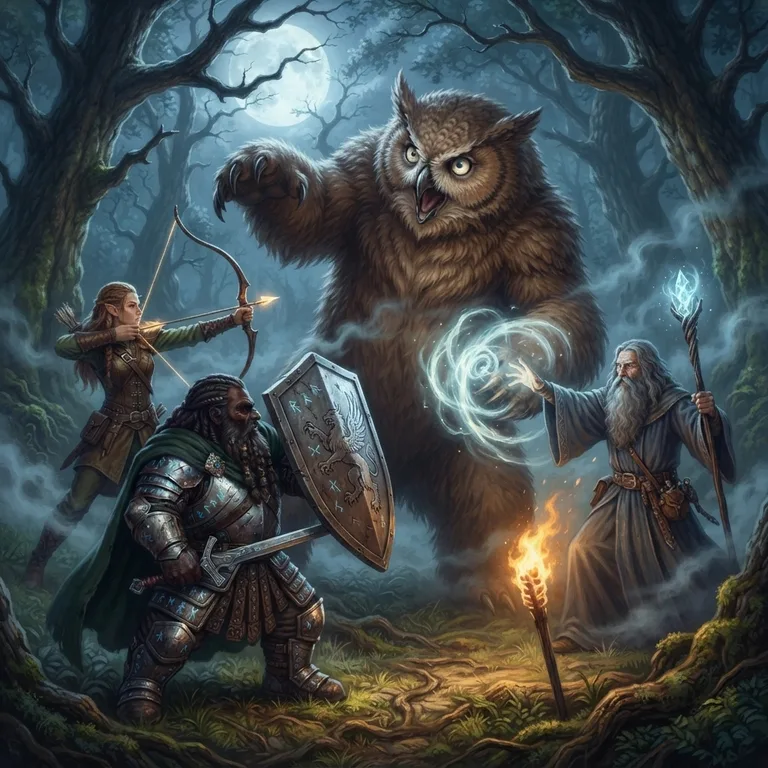
What a Balanced Encounter Actually Is
A balanced encounter is not one the party barely survives. It is one where the outcome is in doubt for a few rounds, the players spend something to win (hit points, spell slots, a potion, a risky move), and the result changes what happens next.
The rules give you a starting number, the XP budget, and that number is useful. But the budget only measures how much monster you put on the table. Three other things decide how the fight actually goes:
- Action economy. How many turns each side gets per round.
- Terrain. Where everyone is standing, and what is in the way.
- Objectives. What each side is trying to do besides kill the other.
Get the budget roughly right, then spend your real effort on those three.
I have watched a CR 1/4 goblin ambush nearly end a party and a CR 8 monster fold in two rounds. The math told me neither. Count the turns, look at the map, and ask what the monsters want. Then check the budget to make sure you are not wildly off.
XP Budgets in Plain Terms
Every monster has a Challenge Rating, and every CR is worth a fixed amount of XP: 25 for CR 1/8, 50 for CR 1/4, 100 for CR 1/2, 200 for CR 1, 450 for CR 2, 700 for CR 3. You add up the XP of the monsters and compare the total to a budget based on your party. The two rulebooks do that comparison differently.
The 2014 method: thresholds and a multiplier
- Look up each character's XP threshold for the difficulty you want (Easy, Medium, Hard or Deadly) and add them together. That is your party's threshold.
- Add up the XP of every monster in the encounter.
- Multiply that total by a number based on how many monsters there are. This is the step people forget, and it is the one that matters.
- Compare the adjusted total to your party's thresholds.
The multiplier by number of monsters:
- 1 monster: x1
- 2 monsters: x1.5
- 3 to 6: x2
- 7 to 10: x2.5
- 11 to 14: x3
- 15 or more: x4
For a party of fewer than three characters, use the next multiplier up. For six or more, use the next one down. The multiplier is only for judging difficulty: the party still earns the monsters' normal XP.
XP threshold per character in the 2014 Dungeon Master's Guide, levels 1 to 5:
The 2024 method: one budget, no multiplier
The 2024 Dungeon Master's Guide drops the multiplier. Pick a difficulty (Low, Moderate or High), multiply the per-character budget for your party's level by the number of characters, and spend that XP on monsters. Whatever you buy fits the difficulty, however many creatures that is.
XP budget per character in the 2024 Dungeon Master's Guide, levels 1 to 5:
One example, both ways
Four level 3 characters meet two ogres (CR 2, 450 XP each, 900 XP total).
- 2024: the Moderate budget is 225 x 4 = 900. Two ogres are a Moderate fight.
- 2014: 900 x 1.5 for two monsters = 1,350 adjusted XP. The party's Hard threshold is 900 and Deadly is 1,600, so this is a Hard fight.
Same ogres, different label. The 2014 multiplier is a blunt attempt to price in action economy. The 2024 budget leaves that judgment to you, which is why the next section matters.
Free tool · Oracle (5e) Let the Oracle do the math Pick party level, party size, difficulty and habitat, and the Oracle builds a fight from SRD stat blocks with the XP budget already worked out. A fast first draft you can then adjust. Roll an encounterWhy Action Economy Matters More Than CR
A party of four gets four turns every round. A single monster gets one. That gap is the single biggest reason fights go differently from what the budget predicts.
- One big monster spends its whole turn on one or two characters while the other three hit it freely. Any condition that costs it a turn (stunned, frightened, restrained, paralyzed) costs it all of its offense.
- Many small monsters spread their attacks, soak up single-target spells, and keep acting even after the first few drop. Five goblins hit more often than one ogre, even when the ogre hits harder.
- Area spells flip the math. A group bunched together can lose most of its hit points to one
 FireballFireball3rd-level EvocationCastingActionRange150 feetDurationInstantaneousSaveDexterityDamage8d6 FireA bright streak flashes from you to a point you choose within range and then blossoms with a low roar into a fiery explosion., or most of its turns to one
 Hypnotic PatternHypnotic Pattern3rd-level IllusionConcentrationCastingActionRange120 feetDuration1 minuteSaveWisdomYou create a twisting pattern of colors in a 30-foot Cube within range. The pattern appears for a moment and vanishes. Each creature in the area who can see the pattern must succeed on a Wisdom saving throw or have the Charmed condition for the duration.. Spread them out and that stops happening.
Practical rule: when you are unsure, add a body rather than more hit points. A second, weaker monster changes a fight more than doubling the first one's health.
Encounter shapes, from most reliable to least


The Solo Boss Problem
Players want to fight the dragon. A single dragon is a hard fight to run well, because of everything above: it gets one turn, and one failed saving throw against a spell like  BanishmentBanishment4th-level AbjurationConcentrationCastingActionRange30 feetDuration1 minuteSaveCharismaOne creature that you can see within range must succeed on a Charisma saving throw or be transported to a harmless demiplane for the duration. While there, the target has the Incapacitated condition. can take it out of the fight entirely.
The monster designers know this, which is why the big ones come with tools to fight back:
- Legendary Resistance lets the creature choose to succeed on a saving throw it failed, a limited number of times. It exists so one spell cannot end your climax.
- Legendary actions give the creature extra actions at the end of other creatures' turns, so it acts more than once per round.
- Lair actions add effects in the creature's home ground.
If your boss has none of those, give it help:
- Add minions. Two to four weaker creatures that protect the boss and pull the party apart. The boss now has bodyguards and the players have choices.
- Use phases. At half hit points the boss changes: flees to a second room, calls reinforcements, breaks the floor, or drops its disguise. A phase change resets a fight that has turned into a slog.
- Give it reactions. A parry, a counterattack, a step back. Something the boss does on the players' turns.
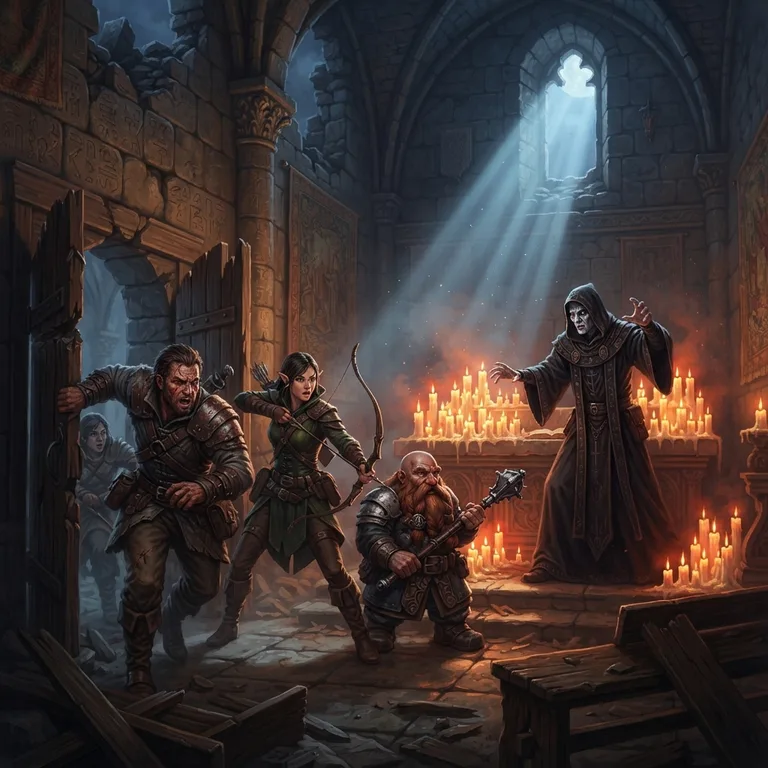
- Give it somewhere to be. A boss on a ledge, behind a chasm or in the middle of a ritual circle is harder to swarm than one standing in an empty room.
If a boss goes down in one round, I do not take it back. The players earned that. I make a note to bring two of its friends next time, and I let the table enjoy the story they will tell about it for a year.
Terrain and Objectives
An empty room with monsters in it is a damage race. Add a few features and the same monsters play like a different fight.
Terrain that does work:
- Cover. Half cover gives +2 to AC and Dexterity saving throws, three-quarters cover gives +5. Pillars, crates and low walls change where archers and casters want to stand.
- Difficult terrain. Rubble, mud or undergrowth costs extra movement, so melee characters cannot simply walk up to the archers.
- Elevation. A ledge, a balcony or a rope bridge splits the map into places that are easy and hard to reach.
- Hazards. A fire, a pit or a fast river. Something both sides can shove the other into.
Objectives that are not "kill everyone":
- Stop the ritual before the third round ends.
- Get the prisoner out the far door.
- Hold the gate until the bell rings.
- Grab the stolen relic and run.
An objective lets you run a hard fight without it being a deadly one. The party can win without dropping every enemy, and the monsters have a reason to do something other than stand and swing.
- Give every fight at least one feature the players can use
- Give monsters a goal, and a point at which they run
- Put ranged enemies where the party has to work to reach them
- Tell the players when a fight is optional
- Empty rectangular rooms with monsters in the middle
- Terrain that only helps the monsters
- Monsters that fight to the death for no reason
- Three identical fights in a row
Adjusting a Fight Mid-Combat
You will misjudge some fights. That is normal, and you have more levers than fudging dice.
If it is too hard:
- Change behavior before numbers. Monsters take a prisoner instead of finishing a downed character, fight over loot, or go after the thing they actually came for.
- Let them break. Most creatures do not fight to the death. When the leader falls or half the group is down, the rest flee or surrender.
- Hold back the reinforcements you were planning to bring in.
- Offer a way out. A side door, a parley, a collapsing tunnel that splits the fight in two.
If it is too easy:
- Bring the reinforcements in on round two or three, from a direction the party did not cover.
- Raise the stakes. The ritual speeds up, the fire spreads, the prisoner is dragged toward the far door.
- Let it be easy. Not every fight needs to be close. An easy win after two hard ones feels great.
The one thing to avoid is changing a monster's hit points or damage after the players have planned around them. Players notice, even when they cannot prove it, and it makes their tactics feel pointless.
A Quick Recipe for Tonight
Running It at the Table
- Describe the ground first. Before initiative, tell the players about the cover, the ledge and the fire. They cannot use terrain they do not know about.
- Telegraph big attacks. "The ogre rears back with the whole tree trunk." A warning turns a hit into a decision.
- Track monster morale, not just hit points. Keep a note of when each group breaks, and stick to it.
- Keep turns fast. Roll monster attacks and damage together, and group identical monsters in one initiative slot.
Running a game alone with no one behind the screen? The free Oracle (5e) answers yes-or-no questions and rolls encounters and complications for you, and Mythic GME vs. an AI Dungeon Master compares the two ways to play without a DM.
Spend a night on the players' side of the screen. Start an adventure in your browser with an AI Dungeon Master running the monsters, and see how your own fights feel from the other chair.
Play freeFAQ
How do you balance an encounter in 5e?
Add up the monsters' XP and compare it to your party's budget for the difficulty you want. In the 2014 rules, multiply the monster XP by a number based on how many monsters there are first. In the 2024 rules there is no multiplier. Then adjust for action economy, terrain and what the monsters are trying to do.
What is the encounter multiplier in 5e?
A 2014 Dungeon Master's Guide rule that multiplies total monster XP by 1 for one monster, 1.5 for two, 2 for three to six, 2.5 for seven to ten, 3 for eleven to fourteen and 4 for fifteen or more. It only affects how difficult the fight is judged to be, not the XP the party earns. The 2024 rules removed it.
Is CR a good way to balance encounters?
It is a rough guide for one monster against a party of four. It does not account for how many monsters there are, the terrain, or the party's spells, so a fight built on CR alone can swing far easier or harder than expected. Use it with the XP budget and adjust from there.
How many encounters should there be per adventuring day?
There is no fixed number. Classes that recover on a Long Rest are strongest when there are few fights, and classes that recover on a Short Rest catch up when there are more. Several moderate fights with a Short Rest between them tends to keep everyone useful.
How do I make a solo boss fight harder?
Give it more turns, not more hit points. Add two to four minions, use legendary actions if it has them, give it a reaction, or change the fight at half hit points with a second phase or reinforcements.
What should I do if a fight is too hard for my players?
Change what the monsters do before changing their numbers. Have them flee when their leader falls, take prisoners instead of finishing downed characters, go after an objective, or leave the party a way out.
Keep reading
Be on the other side of the fight
Start an adventure in your browser and let an AI Dungeon Master run the monsters for once. Play solo, or bring the friends you usually DM for.
This guide includes material from the System Reference Document 5.2 by Wizards of the Coast LLC, licensed under the Creative Commons Attribution 4.0 International License. TableForge is not affiliated with Wizards of the Coast. Full licenses.