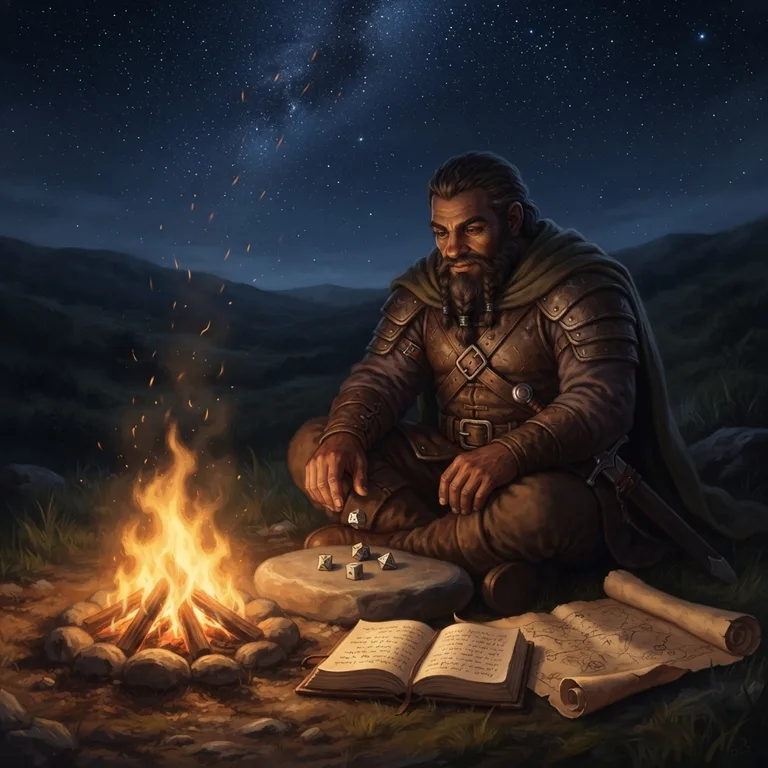
What Running a Solo Game Means
In a solo game you play one character (or a small party) and you are also the Dungeon Master. The trouble is obvious: you cannot surprise yourself. If you decide whether the guard is asleep, you will decide whatever suits you, and the story goes flat.
The fix is an oracle, sometimes called a GM emulator. Instead of deciding, you ask the world a yes-or-no question, say how likely the answer is, and roll. The dice decide, and you interpret. Add a table of random events so the world can act on its own, and a list of open threads so you remember what is going on, and you have a game that pushes back.
This guide is the DM side of solo play: how to ask, how to weight, how to read the answer, and how to keep the game moving. If you want the player side, which class survives alone, see Best Class for Solo Play. For a wider look at the options, from solo adventure books to an AI DM, read how to play D&D solo.
The oracle is not there to write your story. It is there to stop you writing the boring one. Ask it the questions you would rather not answer yourself, and take what it gives you, even when it stings.
What You Need Before You Start
- A character with a concrete goal. Not "become a hero" but "find out who burned my mother's mill". A goal tells you which questions to ask.
- An opening scene. A place, a time, and a problem already in motion. "Dusk, a flooded crossroads, the ferry is gone and something is moving in the water."
- An oracle. Any weighted yes/no table works. The free Oracle (5e) does the rolling and the reading for you, or use a d100 and a chart.
- A notebook with three lists: open threads, NPCs, and things you have established as true.
- The rules you already know. Combat, checks and saving throws run the normal way. The oracle only answers questions the rules do not.
Asking Good Yes/No Questions
The quality of a solo game depends on the quality of the questions. A good question is about the world, has a clear yes and a clear no, and either answer moves the scene forward.
Ask about what your character would actually notice or test: "Is the door barred from the inside?", "Does the innkeeper recognize the seal?", "Is anyone still in the tower?" Then act on the answer.
- Questions where both answers are interesting: "Is the bridge still standing?"
- Questions your character could find out: "Do I hear voices behind the door?"
- One fact at a time. "Is the camp guarded?" then "Is the guard awake?"
- Questions that test your assumptions: "Is the merchant telling the truth?"
- Questions the rules already answer. Do not ask if you hit the goblin; roll the attack.
- Open questions like "What is in the chest?" Turn them into yes/no: "Is there gold in it?"
- Two questions in one: "Is the cult here and are they armed?"
- Asking again because you did not like the answer. The first answer stands.
Setting the Odds
Before you roll, decide how likely a yes is, from what you already know. This is where you act as a fair DM: weight it the way the world would, not the way your character hopes.
The Oracle (5e) uses nine steps, from Impossible to Certain, with Even odds in the middle. A few rules of thumb:
- Lean on what you have established. It is past midnight in a sleepy village: "Is the tavern still open?" is Unlikely. It is festival night: Likely.
- Use Even odds only when you truly have no idea. If you find yourself picking it every time, you are skipping the most useful part.
- Certain and Impossible are not wasted. You ask them to check for surprises. A Certain yes can still come back as a no once in a long while, and that is a story.
- Do not weight toward what you want. If you hope the door is unlocked, that is a reason to be strict, not generous.
Reading the Answer
A plain yes or no is too blunt for a whole session, so the Oracle gives six results. Here is one question read six ways. You are trying to cross the river at night, and you ask: "Is the ferryman still at the crossing?" (Likely).
- Yes, and: he is there, the lantern is lit, and he was told to wait for you. Who told him?
- Yes: he is there and will take you across for the usual fare.
- Yes, but: he is there, but he is drunk, or he wants triple the fare, or he has a passenger already.
- No, but: he is gone, but his boat is tied up and the oars are in it.
- No: he is gone. Find another way across.
- No, and: he is gone, and the boat has been holed. Someone does not want anyone crossing tonight.
Three habits keep interpretation fast:
- Take the first reading that makes sense. Do not hunt for the perfect one. You can explain it later.
- Make "but" a cost, not a cancel. A "yes, but" still gives you what you asked for. Add a price: time, money, noise, a new enemy.
- Let surprises become threads. "Who told him to wait?" goes on the thread list. You do not have to answer it now.
Random Events and Complications
Questions only cover what you think to ask. Random events cover everything else: the world acting on its own, whether you asked or not.
In the Oracle, any double on the yes/no roll (11, 22, 33 and so on) fires a random event alongside the answer. The answer still stands; something else happens too. You can also roll an event on purpose whenever the scene stalls.
An event has a focus, which says what it lands on (an NPC acts, a thread advances, a setback, a break in your favor, a new thread), and two words to read against it. "NPC acts / betray, oath" with the miller on your NPC list means the miller has broken a promise to someone. Read the words in the light of what is already in play, and pick the most interesting fit.
Free tool · Oracle (5e) Roll a random event When the scene stalls or the oracle rolls doubles: a focus that tells you who or what it lands on, plus two words to interpret. Roll an eventWhen the focus names a thread or an NPC, pick from your lists. If you have five open threads, roll a d6 and reroll a 6, or just pick the one that fits the words best. This is why the lists matter: events are only as good as the material you give them.
When the focus does not fit, nudge it. "NPC offers help" in an empty desert can be a traveler on the horizon, a message from a friend, or an old favor called in. Do not throw a result away because it is awkward. Awkward results make the best scenes.
Keeping a Thread List
A thread is anything unfinished: a goal, a mystery, a debt, a person who wants something from you. Write each one as a short question you want answered.
- "Who burned the mill?"
- "Will the ferryman's employer come looking for me?"
- "What is the sealed letter from the abbot?"
Keep the list short. Five or six open threads is plenty; past that, events land on things you have forgotten and the story sprawls. When a thread resolves, cross it out and write a line about how. When an event closes a thread, close it, even if you were not done with it.
Keep an NPC list next to it: name, what they want, and how they feel about you. When an event says an NPC acts or turns hostile, this list tells you who. The Improvise NPCs guide has more on giving each one a want and a secret.
Running Scenes That Push Back
Start each scene by writing what you expect: "I reach the abbey at dawn and the gate is open." Then test it. Ask the oracle "Is it as I expect?" at Likely odds. On a yes, play the scene you planned. On a "yes, but", play it with a twist. On a no, something has changed, and you work out what.
When a scene is going too smoothly, or you have walked into a dungeon room with nothing in it, roll a complication. It tells you what goes wrong, what it puts at risk, and how soon. "The person you needed to talk to is missing, it threatens your lead, and it happens now" turns an easy interview into a search.
Free tool · Oracle (5e) Roll a scene complication For when things are going too well: what goes wrong, what it threatens, and how soon it lands. Roll a complicationRun fights by the book. Use the stat blocks and roll for the monsters honestly, in the open. For their tactics, ask the oracle: "Does the bandit captain retreat?" at odds that match how the fight is going. The Oracle (5e) can also build a fight for your level and roll an NPC or a conversation when you need someone to talk to.
Avoiding Solo Paralysis
The most common way solo games die is not a bad roll. It is twenty minutes of asking questions and never doing anything. You have nobody across the table to say "so, what do you do?", so you need habits that say it for you.
- Act after two or three questions. Questions set the scene; actions move it.
- When stuck, roll a random event and follow it.
- Play short sessions, 30 to 60 minutes, and stop on a question you want answered.
- Write the next session's first question before you close the notebook.
- Keep the goal on top of the page so every scene points somewhere.
- Asking questions to avoid risk. If you would not roll it at a real table, do not ask it.
- Rewriting a result you did not like.
- Planning several scenes ahead. The oracle will wreck the plan, so do not spend the time.
- Tracking every coin and arrow. Track what matters to the story and round the rest.
If you have asked four questions in a row and your character is still standing in the doorway, you are not playing, you are stalling. Walk through the door. The oracle has more to say about what is on the other side than about the doorway.
A Solo Session, Start to Finish
Here is how ten minutes of a solo game might go, for a ranger hunting whoever burned the mill.
- Scene setup: "I follow the cart tracks to the old quarry at dusk. I expect it to be empty." Is it as expected? (Likely) No, but. Someone is there, but not who you feared.
- Question: Is it someone I know? (Even odds) Yes. It is the miller's son, the one who said he was in town that night. He goes on the NPC list.
- Action: You step out and call his name. That is a social scene, so you roll Insight when he answers. A low roll: you cannot tell if he is lying.
- Question: Does he run? (Likely) Yes, and the roll is 11, a double. Random event: NPC acts / conceal, fire. He is not running away, he is running to something: a lantern, a cache, oil. He means to burn the evidence.
- New thread: "What is hidden in the quarry?" Now you have a chase, and a reason to win it.
Notice what did the work: two plain questions, one rules roll, and one event that turned a quiet scene into a race. You did not plan any of it.
For other ways to play alone, compare Mythic GME and an AI Dungeon Master, or solo adventure books and an AI DM. If you have one friend instead of none, see playing D&D with one friend.
Some nights you want to be the DM and the player. Other nights you just want to play. Let an AI DM run the world and answer your questions while you play your character.
Play freeFAQ
How do you DM for yourself in D&D?
Use an oracle. When you do not know what the world does, ask a yes/no question, decide how likely a yes is, and roll. Interpret the answer, write down anything new, and keep acting. Random events let the world surprise you.
What is a GM emulator?
A set of tables that stands in for the Game Master's decisions. The core is a weighted yes/no oracle, usually with random events and a way to track threads and NPCs. Mythic GME is the best-known one; the free Oracle (5e) is another.
Do I need Mythic GME to play solo D&D?
No. Any yes/no table weighted by odds works, plus some way to roll random events. Mythic is popular, but a d100 and a simple chart, or a free online oracle, will run a solo game.
How do you surprise yourself when you are your own DM?
Let the dice decide what you would otherwise decide. Ask the questions whose answers you would like to control, weight them honestly, take the first answer, and roll random events and complications when a scene looks too easy.
How do you run combat in solo D&D?
With the normal rules. Use the monsters' stat blocks, roll their attacks in the open, and ask the oracle about their choices, such as who they target or whether they flee. Pick fights that suit one character, or run a small party.
Keep reading

Or let an AI DM run it
Some nights you want to make the rulings, and some nights you just want to play. TableForge gives you an AI Dungeon Master in your browser: build a character, start a solo campaign, and bring friends later if you want.
This guide includes material from the System Reference Document 5.2 by Wizards of the Coast LLC, licensed under the Creative Commons Attribution 4.0 International License. TableForge is not affiliated with Wizards of the Coast. Full licenses.