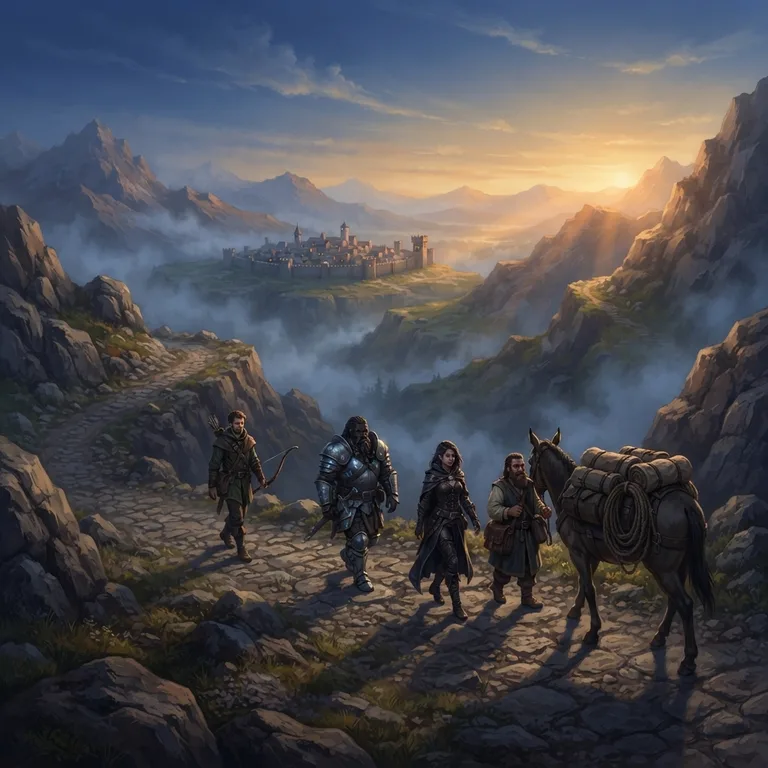
Why Travel Feels Dead, and How to Fix It
Most travel in D&D goes one of two ways. Either the DM says "three days later, you arrive," or the party rolls through a random encounter that has nothing to do with anything. Neither one makes the journey feel like a journey.
Travel matters when it does at least one of these:
- It costs something. Time against a deadline, food, hit points, a horse.
- It asks for a choice. The fast road past the bandits or the slow one through the marsh.
- It shows the players the world. A burned farm, a pilgrim going the other way, a town that is scared of something.
If a trip does none of those, skip it in a sentence. If it does even one, give it a few minutes of table time and a simple daily procedure, so the players feel the distance without the session grinding to a halt.
I have drawn a lot of maps, and the roads are never the interesting part. The interesting part is the bridge that washed out, the inn with no one in it, and the shortcut the locals swear by. Put those on the road and nobody will ask you to skip ahead.
Montage It or Play It Out
Before every trip, decide how much of it to run. The question is simple: is the road itself the adventure, or just the way to it?
- There is a deadline and every day counts.
- The land is dangerous: no road, bad weather, something hunting them.
- Supplies are running low and the players have to choose what to spend.
- The trip is new to the players and you want them to learn the region.
- The route is known and safe: the road between two friendly towns.
- Nothing the players do on the way would change how they arrive.
- The session is short and the real scene is waiting at the other end.
- They have already made this trip, and nothing has changed.
A good montage is still a scene. Give it one roll of weather and one detail, then hand it to the players: ask each player one question about the journey. "What did you see on the second night that you have not told the others about?" "Who did your character talk to at the ferry?" Two or three answers and you have a trip that felt like something, in five minutes, and often a hook you did not plan.
A Daily Travel Procedure
When you play travel out, run each day the same way. A fixed order keeps it moving, and the players learn what to expect and start planning around it.
Travel pace is the first real choice. The rules give a day of travel as eight hours, covering about 30 miles at a fast pace, 24 at a normal pace and 18 at a slow pace. Difficult terrain cuts that distance in half. Fast pace makes the group worse at spotting trouble. Slow pace is the one to pick when the party wants to move quietly or search carefully as they go. Pushing on past eight hours in a day risks Exhaustion.
Those numbers are enough to tell the players, "The pass is 40 miles. At a fast pace that is a day and a half, and you will be easier to ambush." Now pace is a decision, not bookkeeping.
Free tool · Oracle (5e) Roll a day on the road Pick the terrain (road, forest, hills, mountains, marsh or coast) and the Oracle rolls one day of travel: the weather, how the going is, and one thing the party notices. Roll a passageWeather and Terrain That Change Decisions
Weather is only worth describing if it changes something. Every time you name the weather, tie it to one consequence:
- Rain washes out tracks, soaks tinder, and turns a ford into a swim.
- Fog hides the party as well as the ambush, and makes navigation harder.
- Heat makes water the thing everyone is counting.
- Cold makes a fire and shelter urgent. Extreme heat and cold have rules for Exhaustion in the Dungeon Master's Guide, worth using when the weather is the enemy.
- Wind carries scent and sound: the wolves smell you, or you hear the camp before you see it.
Terrain does the same job over a longer stretch. Give each kind of country its own problem:
- Road: fast and easy, so the danger is people. Tolls, patrols, other travelers with their own business.
- Forest: short sight lines and easy to lose the path. Good for ambushes and for things that watch without attacking.
- Hills: slow climbs and long views. The party can see the next valley, and anyone on the next ridge can see them.
- Mountains: difficult terrain, cold nights, narrow passes. One bad day of weather can close a route.
- Marsh: slow, wet and hard to navigate. Disease, insects, and things under the water.
- Coast: tides, cliffs and ships. The road follows the shore until the shore does not cooperate.
Navigation and Getting Lost
Only ask for a navigation check when the party is off the road and cannot see where they are going. A Wisdom (Survival) check from whoever is navigating is the usual roll, harder in thick forest, marsh, or bad weather.
The mistake is to make a failed check mean "you are lost, nothing happens." Make it cost something instead:
- Lost time. They arrive a day late, and the deadline just got tighter.
- The wrong place. They come out at a different village, a ruin, or a camp they were not looking for. Often this is better than where they meant to go.
- Late discovery. Do not tell them on the roll. Tell them at noon, when the river is on the wrong side.
A  RangerRangerClassHit died10SavesDEX, STR or a
 DruidDruidClassHit died8SavesINT, WIS usually takes the navigator's job, and a few spells end the question entirely:
 Find the PathFind the Path6th-level DivinationConcentrationCastingMinuteRangeSelfDuration1 dayYou magically sense the most direct physical route to a location you name. at high level,
 Locate ObjectLocate Object2nd-level DivinationConcentrationCastingActionRangeSelfDuration10 minutesDescribe or name an object that is familiar to you. You sense the direction to the object's location if that object is within 1,000 feet of you. If the object is in motion, you know the direction of its movement. if they know what they are looking for. Let those work. The player spent a spell slot to skip the problem, so the problem should be skipped.
- Give the party a landmark they can steer by: a peak, a river, a tower.
- Let good maps and local guides make the check easier or unneeded.
- Turn a bad roll into a new place, not a wasted hour of play.
- Rolling to navigate on a road with signposts.
- Telling the players they are lost and making them roll until they are not.
- Ignoring the spell or feature a player picked to solve exactly this.
What to Put at a Stop
A stop is anywhere the party slows down: a village, a ferry, a shrine, a farmhouse. Each one should give the players something to do, not just somewhere to buy rations. Here is what earns its place, best first.


Every village on my maps has a name and one problem written under it in small letters. The name is for the players. The problem is for me, so I always know what is happening when they walk in.
Food, Water and Supplies: Track Them or Not
Tracking every ration is only fun when running out is a real danger. In a desert crossing, a winter march or a long siege, food and water are the story, so count them. On a road with an inn every day, wave it through and mark a few gold coins.
If you do track supplies, make the players' choices count:
- Foraging takes a job. The character gathering food is not watching for trouble.
- Spells change the math.
 GoodberryGoodberry1st-level ConjurationCastingActionRangeSelfDuration24 hoursTen berries appear in your hand and are infused with magic for the duration. A creature can take a Bonus Action to eat one berry. Eating a berry restores 1 Hit Point, and the berry provides enough nourishment to sustain a creature for one day.,
 Create or Destroy WaterCreate or Destroy Water1st-level TransmutationCastingActionRange30 feetDurationInstantaneousYou do one of the following: and
 Purify Food and DrinkPurify Food and Drink1st-level TransmutationRitualCastingActionRange10 feetDurationInstantaneousYou remove poison and rot from nonmagical food and drink in a 5-foot-radius Sphere centered on a point within range. can feed and water a party. That is a reward for the player who prepared them, not a problem to design around.
- Camp is a scene.
 AlarmAlarm1st-level AbjurationRitualCastingMinuteRange30 feetDuration8 hoursYou set an alarm against intrusion. Choose a door, a window, or an area within range that is no larger than a 20-foot Cube. Until the spell ends, an alarm alerts you whenever a creature touches or enters the warded area. and
 Tiny HutTiny Hut3rd-level EvocationRitualCastingMinuteRangeSelfDuration8 hoursA 10-foot Emanation springs into existence around you and remains stationary for the duration. The spell fails when you cast it if the Emanation isn't big enough to fully encapsulate all creatures in its area. make a night safer, and who stands which watch decides who is awake when something comes.
Exhaustion is the stick behind all of it. Use it when the players gamble and lose, not as a tax on every day.
Running It at the Table
Here is a three-day journey through hills to a mountain pass, run in about half an hour of real time. Each day gets one beat, and the stop gets the most time.
Running a game for yourself? The same procedure works with the Oracle (5e) answering what is on the road. The solo play guide covers the rest of running both sides of the table.
Want to ride the road for once? Start an adventure where an AI Dungeon Master runs the weather, the waystations and the strangers, and you decide which fork to take.
Play freeFAQ
How do you make travel interesting in D&D?
Give it a cost, a choice, or something to see. Use a short daily procedure: pace and route, jobs, weather, navigation if needed, one notable thing, then camp. Put a problem at every stop, and montage any trip where nothing would change.
How far can you travel in a day in 5e?
In a standard eight-hour travel day, about 30 miles at a fast pace, 24 miles at a normal pace, and 18 miles at a slow pace. Difficult terrain halves the distance. Traveling longer than eight hours risks Exhaustion.
How do you handle getting lost in D&D?
Only call for a navigation check off the road with no landmark in sight, usually Wisdom (Survival). Make a failure cost time or send the party somewhere unexpected, rather than stopping play while they try again.
Should you use random encounters while traveling?
Use them sparingly and tie them to the place. One notable thing a day is enough, and it does not have to be a fight. A traveler, a ruin or a sign of danger ahead often does more than a random monster.
How do you run a travel montage in D&D?
Describe the weather and one detail, then ask each player one question about what their character saw or did on the way. A few answers make the trip feel real in five minutes and often give you a new hook.
Keep reading

Take the long road as a player
Start an adventure in your browser and let an AI Dungeon Master describe the weather, the waystations and the thing on the ridge, while you decide which way to go.
This guide includes material from the System Reference Document 5.2 by Wizards of the Coast LLC, licensed under the Creative Commons Attribution 4.0 International License. TableForge is not affiliated with Wizards of the Coast. Full licenses.