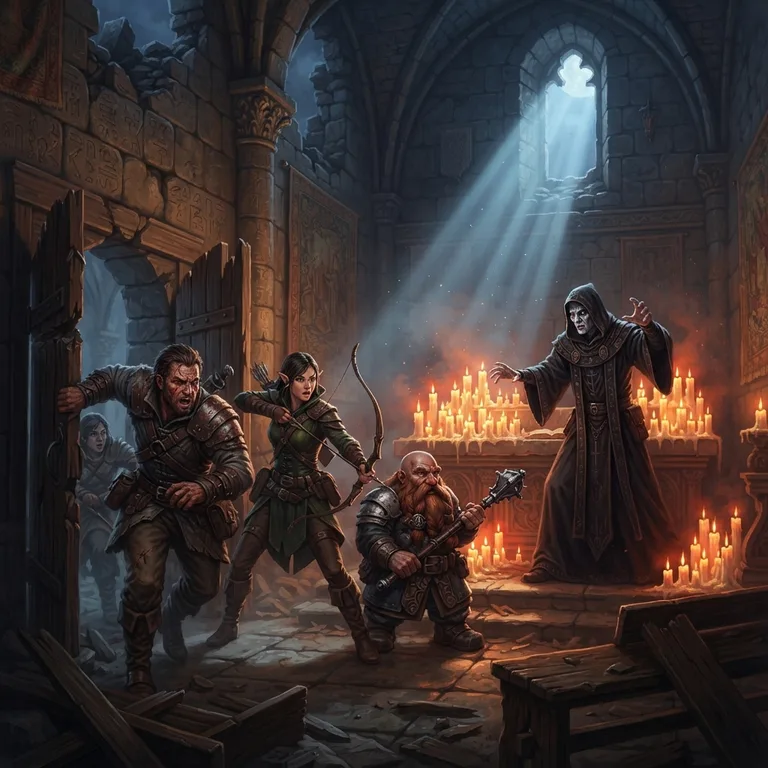
What Makes a One-Shot Work
A one-shot is a complete adventure in one sitting, usually three to four hours. It is not a campaign session that happens to stop. It needs a beginning, a middle and an ending, and the ending has to arrive before people start checking the time.
Three things make that happen:
- A premise small enough to finish. One goal, one place, one villain, one deadline.
- Characters ready on arrival. Pregenerated characters with a reason to be there, so play starts in minutes, not an hour.
- A timeline you actually watch. Three or four scenes, each with a target time, and a plan for what to cut when you fall behind. You will fall behind.
Every one-shot I have seen fail ran out of time, not ideas. The DM prepared five scenes, played two and a half, and the dragon never left its cave. Prepare less, and prepare an ending you can reach from anywhere.
Picking a Tight Premise
Write the premise as one sentence: who needs what done, by when, and what is in the way. If you cannot fit it in one sentence, it is a campaign.
- Rescue: "The toll-keeper's daughter was taken by gnolls. Get her back from their camp in the ravine before the moon sets."
- Heist: "The relic in the bishop's vault is moved to the capital at dawn. Steal it tonight, from inside a guarded cathedral."
- Siege: "The dead are walking out of the flooded graveyard. Hold the mill until sunrise and keep the villagers inside alive."
Each one has a clear goal, a deadline that forces a climax, and one location that holds most of the action. The players know what winning looks like from the first scene.
- One goal with a deadline the players can see
- One location, or a short road to one
- One villain with a plan already in motion
- A reason the heroes are involved before the session starts
- A mystery with few suspects and clues that are easy to find
- Travel across a region before anything happens
- A mystery with many suspects and one clue that must be found
- A dungeon to explore room by room with no clock
- Twists that only matter if you know the setting's history
- Factions the players have to learn before they can choose
Pregenerated Characters
Character creation can eat an hour of a four-hour slot. Pregenerated characters give that hour back, and they let you write the characters into the adventure.
- Make one more than you need. Four players, five pregens. The last player still gets a choice.
- Cover the jobs. Someone to stand in front (
 FighterFighterClassHit died10SavesCON, STR or
 PaladinPaladinClassHit died10SavesCHA, WIS), someone to heal (
 ClericClericClassHit died8SavesCHA, WIS or
 DruidDruidClassHit died8SavesINT, WIS), someone to talk (
 BardBardClassHit died8SavesCHA, DEX), and someone to scout and open locks (
 RogueRogueClassHit died8SavesDEX, INT). A blaster like a
 WizardWizardClassHit died6SavesINT, WIS or
 SorcererSorcererClassHit died6SavesCHA, CON is the obvious fifth.
- Pick a level that fits the premise. Level 1 is fragile and simple. Level 3 is a good default: in the 2024 rules every class has its subclass by then, and characters can survive a bad round. Higher levels suit an epic premise but take longer to learn.
- Keep the sheet to one page. List the actions they will actually use. A player who spends five minutes finding a spell description is five minutes of the table waiting.
- Tie each one in. Give every pregen a line on why they are here, one person in the party they already know, and one personal want that the climax can pay off. "The toll-keeper is your brother" makes the rescue personal in one sentence.
Letting players bring their own characters works with a regular group and some prep, but set a level and a deadline for the sheets, and expect the first half hour to go on introductions.
A Three-to-Four Scene Structure
Plan scenes, not rooms. Each scene has a goal for the players, an obstacle, and one thing they must leave with to reach the next scene: a fact, an item or a position.
The turn is the scene most DMs underprepare. If you are short of an idea, roll a complication and ask what it would mean for your villain's plan.
Free tool · Oracle (5e) Roll a twist for scene 3 What goes wrong, what it threatens, and how soon. Read it against your premise and you have the turn. Roll a complicationA Timeline for a Four-Hour Slot
Write the target times on your notes and keep a clock where you can see it. These are start times, in minutes from when you sit down.
The break is your real checkpoint. If you are not finished with scene 2 by then, scene 3 shrinks to a paragraph. Make that call over snacks, not at the table with the clock against you.
Cutting Scenes Without Anyone Noticing
Every scene except the climax should be cuttable. Because you wrote down what the players must leave each scene with, you can hand it to them and move on.
- Cut to the door. "An hour before dawn you reach the cathedral's side gate." The journey happened; nobody needs to roll for it.
- Fold a scene into one check. Replace a whole infiltration with a single group Stealth check, and let the result decide whether the climax starts with surprise or with the alarm ringing.
- Let an NPC deliver the clue. A dying guard, a frightened servant, a note on the body. Then go to the next scene.
- End fights when the outcome is clear. Monsters flee, surrender or bargain once the fight is decided. Nobody needs to roll the last three goblins' attacks.
- Drop reinforcements. If you planned a second wave, keep it in your pocket.
The opposite problem happens too: the table stalls, nobody knows what to do, and ten minutes go on debate. Do not wait. Have something happen. Roll a random event and let the world move.
Free tool · Oracle (5e) Roll a random event when the table stalls A focus that says what it lands on, plus two words to interpret. Use it to make the villain act, an NPC arrive or a thread move. Roll an eventA Climax That Lands on Time
The climax is what people remember, so protect its time and build it to finish.
- Put the goal in the fight. The girl is in the gnoll chief's tent, the relic is on the altar, the villagers are in the cellar that is flooding. Winning means reaching the goal, not only dropping hit points to zero.
- Add a clock. The ritual completes at the end of round four. The bridge falls in three rounds. A visible clock makes every turn matter and guarantees an ending.
- Use the terrain. Two features are enough: a rickety bridge, a burning tent, a bell tower, a flooded floor.
- Run it harder than a campaign fight. In a campaign, players save resources for tomorrow. In a one-shot there is no tomorrow, so they will spend every spell slot and ability they have. A Hard fight on the Oracle's scale is a good default for a climax.
- Pay off the pregens. If the bard's want was to hear her brother's voice again, he is in the tent. Give each character a moment.
Plan the off-ramp. Decide before the session what ends the fight early if time runs short: the minions break when the boss is bloodied, the boss tries a desperate escape, the ritual's clock jumps forward. The fight ends either way, and it ends on something dramatic.
Finish with an epilogue. Ask each player what their character does next. Two minutes of that turns a fight into a story people talk about.
For more on fights and the XP budget, see How to Build a Balanced Encounter.
Running It on the Night
- Print or share the pregens before anyone sits down
- Read the premise aloud in one sentence, then start scene 1
- Keep a visible clock and check it at the break
- Say yes to plans that skip a scene. Cut to whatever they skipped to.
- Start the climax on time, even if a scene was cut short
- A long opening speech about the setting's history
- Shopping, unless it is the heist's planning scene
- Splitting the party for more than a few minutes
- Saving the best moment for a scene you might not reach
- Rolling for things that do not matter to the goal
If this is your first time behind the screen, How to DM Your First Session covers the basics, and a one-shot is a good first game to run. New players can pick from the best classes for beginners if they want to choose instead of taking a pregen.
You run the one-shots for everyone else. Play one yourself: let an AI DM run an adventure while you play a character, alone or with friends.
Play freeFAQ
How long should a one-shot be?
Three to four hours is typical, and four is a common slot at conventions and game stores. Plan content for less than the slot: about three hours of scenes for a four-hour game, because introductions, breaks and rules questions take the rest.
What level should a one-shot be?
Level 3 is a good default. Characters have their subclasses (in the 2024 rules, every class gets one at level 3), survive a bad round, and are still simple to learn. Level 1 suits brand new players; higher levels suit an epic premise.
How many encounters should a one-shot have?
Two or three fights is plenty: a short one in the opening scene and the climax, with maybe one in the middle. The rest of the time goes to exploration and talking. Every extra fight is time taken from the climax.
Should I use pregenerated characters for a one-shot?
Usually, yes. Pregens save the hour character creation would take, cover the party's jobs, and let you write each character into the premise. Let players bring their own only with a regular group and a clear level and deadline.
How do you end a one-shot on time?
Give the climax a full hour and start it on time, even if you cut earlier scenes. Put a visible clock in the final fight, and plan an off-ramp, like minions fleeing, in case the fight runs long. Finish with a short epilogue.
How do you write a D&D one-shot?
Write the premise in one sentence: who needs what done, by when, and what is in the way. Plan three or four scenes, each with what the players must leave with. Make pregens tied to the premise, and build the climax around the goal.
Keep reading

Or sit on the other side of the screen
You run the one-shots. Some nights, play one. TableForge gives you an AI Dungeon Master in your browser: build a character, invite friends or play alone, and start an adventure tonight.
This guide includes material from the System Reference Document 5.2 by Wizards of the Coast LLC, licensed under the Creative Commons Attribution 4.0 International License. TableForge is not affiliated with Wizards of the Coast. Full licenses.