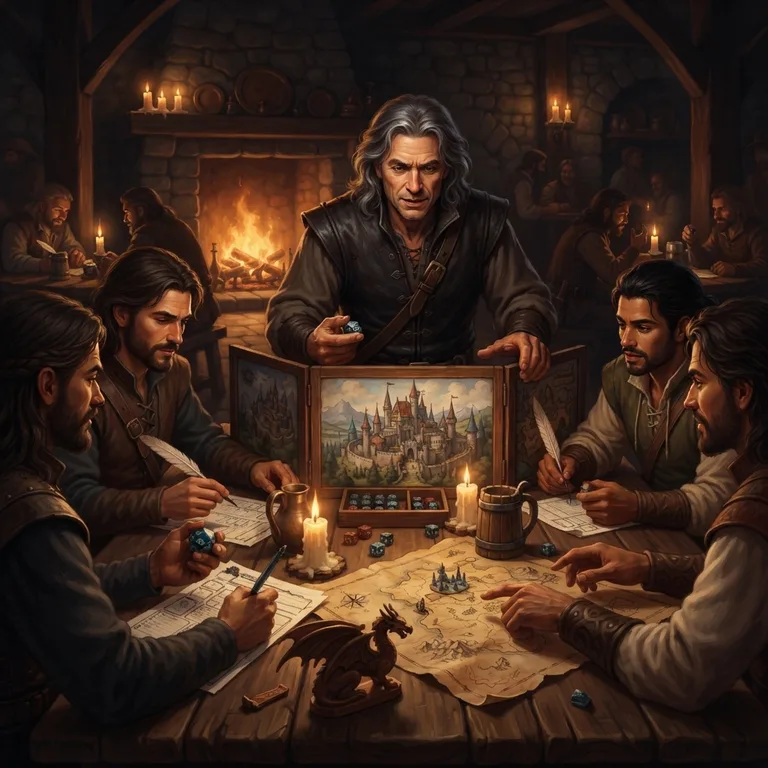
What Your First Session Needs to Do
Your first session does not need to be long, clever or perfectly run. It needs to do four things:
- Everyone knows who they are playing, and roughly why their character is here.
- Something happens in the first fifteen minutes. Not a recap, not a shopping trip: a scene with a problem in it.
- The players make at least one real choice and see it change something.
- It ends with a reason to come back.
Hit those four and the session is a success, even if you looked up grappling three times and forgot the bandit had a crossbow. Players remember what happened, not how smoothly you ran the rules.
My first session as a DM, I prepared forty pages of history for a kingdom. The players spent the evening trying to adopt a goat. They loved it. Prepare the goat, not the kingdom.
Prep That Matters
New DMs over-prepare the wrong things. You do not need a world. You need one evening's worth of situations, ready to bend when the players go sideways. Here is the order to prepare in, and you can stop at any step and still run a good game.
- Names, lots of them, on one index card
- Stat blocks for the fight, already open
- What each NPC wants
- The first two sentences of the session
- History the players will never ask about
- A full map of the region
- Exact dialogue for every scene
- A plan for what the players will do
A published starter adventure is a perfectly good choice for a first session. It hands you the locations, NPCs and fights, and you can spend your prep reading it twice instead of writing it.
Session Zero Lite
A full session zero is a whole evening. For a first game, take fifteen minutes at the start instead and cover five things:
- Tone. Is this heroic, grim, silly, spooky? One sentence each from you and the players.
- Lines and veils. Anything that should never come up (a line), and anything that can happen off screen but not be described (a veil). Ask openly, and tell people they can message you privately too.
- Why the party is together. Give them a reason, or ask each player for one link to another character. "We grew up in the same village" is enough.
- How you will handle rules questions. "I will make a call and we can look it up after the session" saves a lot of time.
- Scheduling. How often, how long, and what happens if someone cannot make it.
New players also need a quick tour of their own sheet: what they roll to hit, what their best skill is, and what their one or two special things do. Five minutes per player, before the game starts.
A Strong Opening Scene
Skip the tavern meeting. Start the characters in the middle of something, together, with a decision to make in the first few minutes.
Good openings:
- The caravan stops. A tree across the road, a wagon on its side, and the driver is missing.
- The festival goes wrong. The bell tower rings at the wrong hour and everyone in the square turns to look at the party.
- The job is already underway. "You have been walking the old mine for an hour. Your lantern is getting low. Something ahead is breathing."
- Someone runs in. A child, a guard or a wounded stranger bursts into the room and asks the party, specifically, for help.
Describe the scene in two or three sentences, end with a question to one player ("Kara, you are closest to the wagon. What do you do?"), and stop talking. That pause is where the game starts.
Free tool · Oracle (5e) Roll the person who starts it all The Oracle rolls an NPC with a portrait, a want, and a secret. Make them the stranger who asks for help, the missing driver, or the villain's first contact. Roll an NPCThe Three-Act First Session
A first session fits neatly into three acts. Here is a timeline for a three-hour game. Treat the times as rough: if a scene is fun, let it run and cut something later.
If the players spend the whole second act arguing with a merchant, that was the session. Cut act three down to a single scene and end on the hook anyway. Nobody at the table knows what you skipped.
Running the First Combat
The first fight is a tutorial. Its job is to teach everyone how a turn works, and to make each character feel good at something.
- Keep it easy. Level 1 characters are fragile. A wizard often has 6 to 8 hit points, and one critical hit from a single monster can drop them. Use the easy end of the budget from the encounter guide, and fewer monsters than you think you need.
- Explain the turn once, out loud. You can move and take one action, and some characters have a Bonus Action. Then let each player go.
- Describe the results, not the numbers. "Your arrow takes him in the shoulder and he drops his torch" is the reward for a hit.
- Let the monsters run. When half of them are down, the rest flee. That ends the fight before it drags, and the ones who escape can warn someone later.
- Know the dying rules. A character at 0 hit points is unconscious and makes death saving throws: three successes stabilize, three failures kill. Taking damage at 0 counts as a failure, and a critical hit counts as two. A big enough hit can kill a level 1 character outright: if the damage left over after reaching 0 equals or exceeds their hit point maximum, they die.
If nobody has healing, put a couple of Potions of Healing in the first room they search.
Free tool · Oracle (5e) Roll a first fight that fits Set level 1, your party size and Easy, and the Oracle picks SRD monsters within the XP budget for you. Swap a monster out if it does not fit the scene. Roll an encounterRulings Over Rules
You will hit a moment where you do not know the rule, or there is no rule. Make a ruling, keep the game moving, and look it up afterward. Three tools cover almost everything:
- A check against a DC. Pick the ability, then a number: 10 is easy, 15 is medium, 20 is hard. Most things a new DM needs are one of those three.
- Advantage or Disadvantage. If something helps (high ground, a good plan, a distraction), give Advantage. If something hurts (darkness, a broken tool, a rushed attempt), give Disadvantage.
- Just say yes. If failure would not be interesting, the character simply does it. Nobody needs to roll to open an unlocked door.
Two more habits help. Ask the player what they want to achieve, not just what they do, so you can pick the right roll. And when a player knows a rule better than you, let them tell you. It is a shared game.
Free tool · Oracle (5e) When you do not know the answer Does the guard have the key? Is anyone home? Ask the Oracle a yes or no question, weight how likely it is, and let the dice decide. Doubles throw in a random event. Ask the OracleEnding on a Hook
End the session on a question the players want answered. The best hooks are a surprise that still makes sense:
- A reveal. The friendly innkeeper's ring matches the bandit leader's seal.
- An arrival. As the party rests, riders in black come up the road, looking for them by name.
- A choice. The rescued prisoner offers a map to the real treasure, but the village needs the party to stay.
- A consequence. The goblin who escaped in the first fight has reached its master.
Stop there. Do not resolve it. Then ask the table two questions: "What was your favorite moment?" and "What do you want to see more of?" Write down the answers. That is your prep guide for session two.
Many groups level characters to 2 after the first session, whether you track XP (300 XP reaches level 2) or level by milestones. Early levels come quickly by design.
Your players will forget half your plot by next week. They will not forget the cliffhanger. Write it down, put it in the group chat the next day, and you have done the hardest part of DMing: getting everyone back to the table.
Before You Run It
- Read your notes once on the day. Fresh in your head beats perfectly organized.
- Keep a scratch list of every name you make up during play. Those are next session's NPCs.
- Have a drink of water nearby. You will talk more than you expect.
- Forgive yourself. Every DM forgets a rule, loses a note, or lets a fight run long. The players are on your side.
Only two of you? See how to play D&D with one friend. Nobody wants to be the DM yet? D&D without a DM covers the options.
Not ready to run it yet? Start an adventure with an AI Dungeon Master and play through a session yourself. Then take what you liked to your own table.
Play freeFAQ
How do I DM for the first time?
Prepare an opening scene that starts in motion, one problem, three locations, three NPCs with a want and a secret, and one easy fight. Spend fifteen minutes on tone and safety at the start, make rulings instead of looking up rules, and end on a hook. A published starter adventure handles most of the prep for you.
How long should a first D&D session be?
Three to four hours is typical. For brand new players, two to three hours is plenty: long enough for an opening, one fight and a hook, short enough that nobody gets tired.
What level should a first D&D session start at?
Level 1 is the classic start for new players, because there is less on the character sheet to learn. Some DMs start experienced players at level 3, where characters are sturdier and have their subclass.
How much prep does a first D&D session need?
Less than you think. One to three hours is plenty for an original session, and less if you use a published adventure. Prepare situations and people, not a plot, because the players will not follow one.
What should happen in a first D&D session?
Something happens in the first fifteen minutes, the party meets at least one NPC who wants something, there is one small fight, the players make a real choice, and the session ends on a hook that makes them want to come back.
What if I do not know a rule during the game?
Make a ruling and keep going. Call for a check with a DC of 10, 15 or 20, or give Advantage or Disadvantage, and look up the rule after the session. Tell the players at the start that this is how you will handle it.
Keep reading

See a session from the other side
Start an adventure in your browser and let an AI Dungeon Master run it while you play. A good way to watch pacing, openings and first fights before you run your own.
This guide includes material from the System Reference Document 5.2 by Wizards of the Coast LLC, licensed under the Creative Commons Attribution 4.0 International License. TableForge is not affiliated with Wizards of the Coast. Full licenses.